

The full-scale war has fundamentally altered the business landscape in Ukraine. In an interview, Bayadera Group CEO Anatoliy Korchynskyi discusses how the company maintains its leadership, expands production, invests in new ventures, and builds a future-oriented business.
— Bayadera Group is a company that not only operates stably amidst the war but also thrives. How do you manage to sustain this growth momentum?
— The full-scale invasion drastically reshaped the operating conditions for Ukrainian businesses, and BAYADERA GROUP was no exception. The company swiftly reconfigured its internal processes, adapting them to the new economic reality. Despite the challenging environment, market dynamics began to show positive trends as early as mid-2022, with growth in imports, exports, and, crucially, the revival of national production.
The Ukrainian alcohol market expanded in 2025, defying the war, production disruptions, and decreased consumption. Bayadera Group emerged as the industry leader for 2025, reporting a consolidated revenue of nearly UAH 12 billion (excluding excise tax and VAT).
We have become adept at responding swiftly to changes, maintaining our pace, and making critical decisions without delay. A key strength of BAYADERA GROUP lies in its diversified business structure. Today, the Group comprises three distinct business units: Bayadera Logistic – responsible for national production and distribution of alcoholic beverages; Bayadera Elite – handling import and distribution of global alcohol brands; and Bayadera Export.
Even during the full-scale war, BAYADERA GROUP has not halted its development. The company is solidifying its domestic market share, boosting exports, and cultivating its own brand portfolio, which includes prominent trademarks such as Hlibny Dar, Kozatska Rada, Persha Gildia, Oxygenium, Nikita, Koblevo, Marengo, and others. Currently, the group’s products are available in 46 countries, and the company remains one of Ukraine’s largest alcohol producers.
Throughout the full-scale war, the company has remitted over UAH 20 billion in taxes and allocated nearly UAH 115 million to support the Armed Forces of Ukraine. This achievement is underpinned by a strong team, rapid decision-making, a diversified business model, and a continuous pursuit of new opportunities, even in times of crisis.
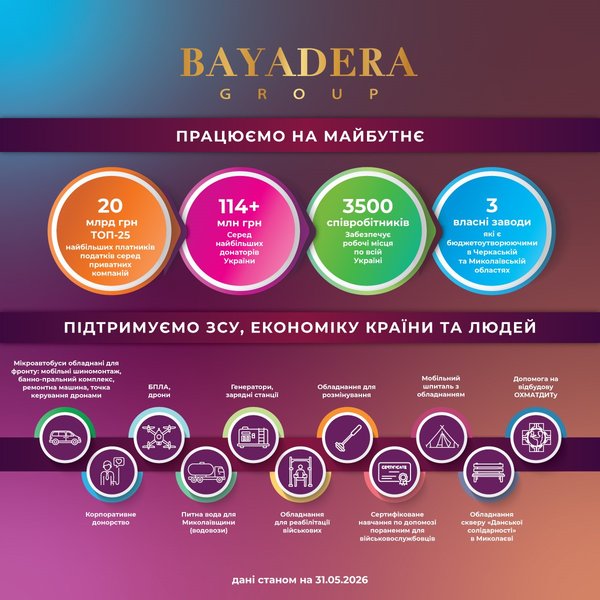
Bayadera Group Data as of 31.05.2026
— The world has become significantly less predictable in recent years. How is risk management evolving in such conditions?
— Previously, risks could be assessed months or even years in advance. Today, that planning horizon is considerably shorter. This doesn’t diminish the importance of strategy, but it demands greater flexibility. We regularly re-evaluate our decisions, are not afraid to adjust plans, and make management decisions much faster than a few years ago.
However, some aspects remain constant. Financial discipline, a robust team, partner trust, and corporate reputation continue to be the strongest defenses in any crisis. These are the pillars upon which our current risk management system is built.
The war has starkly revealed one truth: the greatest asset of a business is its people. Simultaneously, people represent the most significant risk factor. Mobilization, relocations, and labor shortages are particularly acute in manufacturing and logistics, where operations cannot simply be paused. Bayadera Group experienced this immediately. Consequently, the company prioritized systematic efforts over quick fixes. The strength of our people is especially evident in production – experienced employees not only train but also inspire a passion for the profession, often proving more effective than any bonuses.
Motivation is also evolving. Today, people are concerned not just with “how much” but also with “why.” Stability, clarity, and a sense of purpose in one’s work are crucial for retaining the team. The company supports employees through difficult personal circumstances and strives to foster an environment where individuals feel secure and supported.
— You’ve been with Bayadera Group for over 20 years. What does it mean to be the CEO of a major company in Ukraine today?
— I joined the company in 2005 as a branch director. It was there, working directly with people and the market, that I forged my core management principle: results are born from trust, responsibility, and teamwork. The CEO’s role has long extended beyond mere business management. It now entails significant responsibility for the employees, for decisions impacting thousands of families, and for the business’s contribution to the nation’s economy. The war has shifted priorities. While a leader might have previously allocated more time to development, today one must simultaneously address personnel safety, operational continuity, financial stability, and the company’s future. Crucially, it’s important not to lose the capacity for forward-thinking. This, in my view, defines the role of a CEO in a major Ukrainian company today.
— How are technologies transforming the market?
— Technology is now reshaping not only how business is conducted but also the speed at which decisions must be made. We increasingly rely on data analysis, automate processes, and utilize digital tools across logistics, production, sales, marketing, and human resources. This facilitates quicker identification of demand shifts, more efficient resource utilization, and a deeper understanding of the consumer.
Effective January 1, 2025, BAYADERA GROUP initiated a digital transformation initiative in collaboration with Vchasno. The savings achieved through digitalization to date are as follows:
• Total time savings: 301 working days. • Environmental savings: 49.79 trees, 61.7 m³ of water, and 27.099 kg of CO2. Our case study illustrates how digitalization helps businesses optimize processes, eliminate routine tasks, and free up teams for development, strategic planning, and business scaling, while also contributing to environmental preservation.
However, I do not believe that technology can replace experience and a skilled team. Technology offers new possibilities, but the ultimate outcome always depends on the people who effectively leverage them.
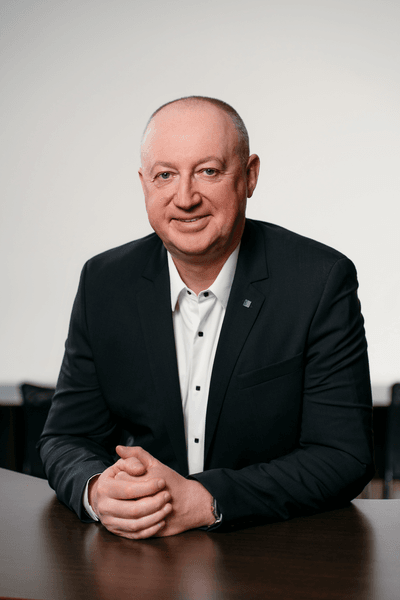
Anatoliy Korchynskyi
— What were Bayadera Group’s results for 2025, and how do you assess the first half of 2026?
— Bayadera Group operates three production facilities in Ukraine: “Koblevo,” “Natsionalna Gorylchana Kompaniia,” and the Mykolaiv Cognac Factory. Their revenues in 2025 were UAH 346 million, UAH 3.2 billion, and UAH 749.5 million, respectively, according to YouControl. The group’s consolidated revenue reached UAH 11.9 billion.
Imports accounted for 39% of the group’s revenue, with sales of imported products reaching a record UAH 5.7 billion in 2025. Key brands include Moët & Chandon, Hennessy, Johnnie Walker, and Jägermeister. Last year, the company signed an agreement with a new Italian wine partner, Toso, the largest producer of Fragolino.
We maintain approximately a 35% share of the Ukrainian vodka market. For instance, in 2025, the vodka brand HLIBNY DAR contributed nearly 40% of the company’s total vodka production volume. Over 103 million bottles (0.5L, 40% ABV) of alcoholic beverages were produced in 2025, with HLIBNY DAR accounting for 42.4 million of these.
The first half of 2026 has been stable, concluding the six months with positive momentum across key business segments. We have successfully strengthened our domestic market position, continued to enhance our import operations, and initiated important investment projects. Significantly, this progress has been achieved not through cutbacks or savings but by boosting efficiency and the dedicated efforts of our team.
Despite all challenges, the company maintains a steady development pace, invests in production, expands the international presence of its brands, and continues to fulfill all commitments to partners, employees, and the state. This, I believe, is the most significant indicator of business performance today.
— In your opinion, what is paramount in doing business in contemporary Ukraine?
— Today, responsibility is paramount. This includes responsibility towards our employees, partners, consumers, and the state. Businesses must honor their commitments regardless of circumstances, as long-term relationships are built on trust. Equally important is maintaining the ability to look ahead. The war has taught us all to live with uncertainty, but it has not negated the need to grow, invest, and seek new opportunities. I am convinced that such companies are currently shaping Ukraine’s economic resilience and laying the foundation for its future.
— What characteristics will define a successful business in the future?
— I believe the business of the future will be one that constantly embraces change. No current successful model guarantees future success. Therefore, the primary competitive advantage will shift from company scale to its ability to adapt rapidly, learn, and implement new solutions. Moreover, the future belongs to companies with a long-term vision. Investments in technology, innovation, employee development, production, and international reach are not expenses but the bedrock of sustainable growth. Businesses must not merely react to change but actively shape it.
— You operate in dozens of international markets. How has the perception of Ukraine as a partner changed since 2022?
— Since 2022, Ukraine is increasingly viewed not just as a market but as a country where businesses demonstrate remarkable resilience and operational capability even under extreme duress. Our expanded international presence, not merely maintained but grown, serves as the best testament to this. BAYADERA GROUP’s products are now exported to 46 countries, a feat made possible by the trust we have cultivated over years. Partners recognize that Ukrainian companies uphold agreements, deliver quality, and remain accountable irrespective of conditions. In my view, this reputation is currently one of Ukraine’s strongest competitive advantages on the global stage. We, in turn, are committed to proudly representing the “Made in Ukraine” brand worldwide.
— Large companies often discuss business resilience, but less frequently address the resilience of their people. What helps your team persevere through five years of large-scale war?
— In challenging times, businesses are sustained not by processes, but by people.
We have all undergone profound changes during these war years. People experience fatigue, worry about loved ones, and often juggle work, air raid alerts, and news from the front. In such circumstances, it is exceptionally important for a company to remain a place where individuals feel supported and confident about the future.
Today, the BAYADERA GROUP team comprises 3,500 employees. Approximately 10% of our staff have been with the company for over 10–20 years.
We maintain open communication with our team, honor our commitments, and support mobilized employees and their families. Perhaps most importantly, a genuine sense of unity has formed within our organization. When people know they can rely on each other, they find the strength to move forward, even during the most difficult periods.
— Could you elaborate on the company’s charitable initiatives and your key focus areas?
— During the war, charity has evolved from a separate initiative to an integral part of daily business responsibility. Our priority from the outset has been supporting the Armed Forces of Ukraine, our mobilized employees, and their families. Throughout the full-scale war, BAYADERA GROUP has channeled nearly UAH 115 million towards supporting the Ukrainian Armed Forces, focusing on equipping military personnel, rehabilitating defenders, demining operations, and implementing socio-humanitarian projects. The company regularly procures and delivers vehicles, drones, quadcopters, diesel generators, thermal imagers, medications, medical equipment, and other essential supplies to the front lines.
Creating jobs, paying wages promptly, investing in production, and honestly paying taxes are equally vital today. Since the full-scale invasion began, BAYADERA GROUP has paid over UAH 20 billion in taxes and fees. According to the State Tax Service, the company ranks among the largest taxpayers in Ukraine’s alcohol industry.
— What are your company’s prospects for the next few years?
— We operate in an environment where long-term forecasting is challenging, but we are clear about our development trajectory. We consistently invest in our business, strengthening our position in Ukraine, expanding our export reach, and developing both our own and imported brands. Our strategic objective is not only to grow in domestic and international markets but also to represent Ukraine as a nation that produces competitive, high-quality goods and projects a modern, strong image globally.
I am confident that post-war, Ukrainian companies will have new avenues for growth. We aim to be prepared for this. That is why we continue to invest in our business today, ensuring that tomorrow we lead the market’s development rather than merely catching up. As Peter Drucker said, “The best way to predict the future is to create it.”
EXCESSIVE ALCOHOL CONSUMPTION IS HARMFUL TO YOUR HEALTH